



Handel’s “Messiah” – Part 5, The Messiah’s Earthly Ministry: Prophecy and Fulfilment
As we continue in our examination of Handel’s Messiah after the Nativity, we come to four Scripture passages used to show the Messiah’s ministry as a prophetic fulfilment.
First is an excerpt from Zechariah 9:9–10:
“Rejoice greatly, O daughter of Zion! Shout, O daughter of Jerusalem! Behold, thy King cometh unto thee! He is the righteous Saviour, and He shall speak peace unto the heathen.”
When we look at the full text, we can see that these verses contain a prophecy that has more than one fulfilment:
“Rejoice greatly, O daughter of Zion; shout, O daughter of Jerusalem: behold, thy King cometh unto thee: he is just, and having salvation; lowly, and riding upon an ass, and upon a colt the foal of an ass.
And I will cut off the chariot from Ephraim, and the horse from Jerusalem, and the battle bow shall be cut off: and he shall speak peace unto the heathen: and his dominion shall be from sea even to sea, and from the river even to the ends of the earth.”
The excerpt that Jennens provided for Handel obviously focuses on the prophecy of the Messiah’s first coming, in the context of the rest of the text for Messiah, while the omitted parts include the foretelling of His ride into Jerusalem on Palm Sunday.
Ultimate Victory
But then Zechariah goes further by foretelling the Messiah’s ultimate victory over evil, uniting “Zion” with “the heathen”, and instituting His dominion of peace “from sea even to sea, and from the river even to the ends of the earth.”
For the sake of our purpose here, it’s significant that we are led from the prophesied birth of the Messiah to the depiction of His ministry by another prophetic Old Testament passage. It’s also significant that first and foremost, Jesus was the promised Messiah to the Jews. The offer of salvation by faith in Jesus was first given to them, as prophesied.
(In relation to the music, I was pleased to find a video of this piece by Australian artists, and I once had the pleasure of meeting the soloist after a concert she performed in St James’ Anglican Church in Sydney’s CBD.)
Miraculous Healing
The next passage is from Isaiah 35:5-6,
“Then shall the eyes of the blind be opened,
and the ears of the deaf unstopped.
Then shall the lame man leap as a hart,
and the tongue of the dumb shall sing.”
This prophetically speaks to the miraculous aspect of the Messiah’s ministry, which, along with His teaching, was its distinguishing factor. It’s also the distinguishing factor regarding His instructions to His disciples, and later to the 72 others, whom He sent out in pairs (Matthew 10:1, 7-8; Luke 10:1,9).
I know there is lingering controversy in some quarters in relation to the miraculous in our day. But it’s my considered opinion, based on experience as well as my understanding of Scripture, that these instructions Jesus gave His disciples are still relevant today. In fact, that these two instances are “Commissions”, in the same way as the “Great Commission” at the end of Matthew’s Gospel.
So the only distinguishing mark of the latter is the fact that Messiah’s earthly ministry has been fulfilled, and He is now bestowing His authority on them to continue, in the same way and by performing the same works as the Messiah has while He was among them.
If you read Luke’s Gospel as a progressive narrative, you find Jesus calling His disciples (chapter 5), then performing numerous miracles in their presence, before basically saying, “Now you go and do the same as I’ve shown you.” This, too, is a progression, first with the inner circle of the Twelve, then again with the 72 representing the outer circle of other followers.
So then, the “Great Commission” is simply taking that process to an open-ended operation that we find ourselves in today. Jesus had already laid out the process of healing the sick, raising the dead and driving out demons. That didn’t require repeating. The only point Jesus needed to reinforce was that of divine authority that He was now delegating to them, as well as the coming of the Holy Spirit (Acts 1:4-5), Who would empower them to perform “even greater works” (John 14:12) than Jesus did.
Meditative Joy
That’s a rather long explanation for a musical passage lasting a mere 30 seconds, which leads directly into the next passage, which juxtaposes two texts, one from Isaiah and one from Matthew. This yet again shows the prophetic nature of the whole work, as the Matthew passage can be seen as the fulfilment of Isaiah:
“He shall feed His flock like a shepherd, and He shall gather the lambs with His arm, and carry them in His bosom, and gently lead those that are with young.” (Isaiah 40:11)
“Come unto Him, all ye that labour, come unto Him ye that are heavy-laden, and He will give you rest. Take His yoke upon you, and learn of Him, for He is meek and lowly of heart, and ye shall find rest unto your souls.” (Matthew 11:28-29)
It’s also interesting that the verses from Matthew take the words that Jesus Himself spoke and shift them into the third person: “Come unto Me…” becomes “Come unto Him…”. This keeps the work in the realm of the meditative, that we’re inspired observers, which runs through Messiah from beginning to end.
(Again, an aside on the video clip: The one I found is not ideal as a performance, but there weren’t many to choose from. This one, though, gave me a thrill, because it is of a Jewish orchestra and soloists, which adds an extra “edge” for me to the prophetic and Messianic nature of this particular passage, as we see “daughters of Zion… rejoice greatly” singing Handel’s Messiah!)
The final musical section of this portion of Messiah, which rounds out Part 1 of the whole work, is simply a treatment of the next verse from the preceding number, “His yoke is easy, and His burthen is light” (Matthew 11:30), but it conveys the joy of those who have discovered for themselves the lightness of the Messiah’s yoke, as it skips along with a light and pure joy.
The next instalment will bring us to the central part of the work, dealing with Easter.
___
Photo by Anastasia Kolchina; image: Berhard Plockhorst/Wikimedia Commons.
Recent Articles:

18 October 2026
2.7 MINS
Every season of life belongs to Christ, and we don't retire from discipleship as we grow older. In fact, our older years hold unique gifts for the younger generations.

17 October 2026
3.4 MINS
Seeking the face of God means surrender, laying aside our agenda and wants. Revival begins when we want God himself more than we want the outcome.
16 October 2026
3.3 MINS
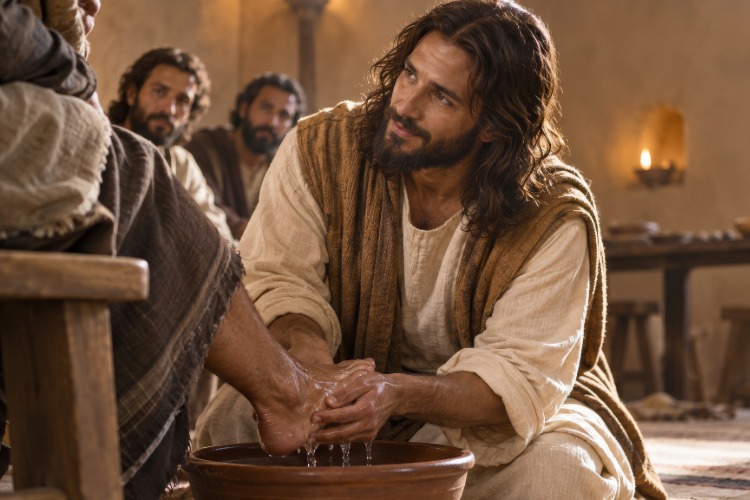
Jesus is calling us to love one another “just as I have loved you”. And if the Church does awaken to that agape (love), the world will see a great and powerful witness to Christ and his kingdom.
15 October 2026
3.6 MINS
An 80,000-strong gathering in Texas signals a hunger for revival, as Pastor Philip Anthony Mitchell warns that Christian indifference could leave future generations without the faith.

15 October 2026
4.2 MINS
Many Australian Christians don’t know a single Aboriginal person. Robyn Murray argues that reconciliation begins with honest history, prayer and a shared life in Christ.

15 October 2026
7.2 MINS
A man’s death in a tiger enclosure sparks chilling online reactions, exposing a growing willingness to judge human worth by usefulness, behaviour and ideology.
15 October 2026
2.6 MINS
Before anything else, we must make prayer central. I urge the Church in Australia to awaken to, first of all, prayer.


