



The Revised National Curriculum is Cancel Culture on Steroids
Editor’s Note: This article first appeared at The Spectator.
The release of the revised national curriculum, once again, has sparked a debate about the study of Judeo-Christianity and Western civilisation in the school curriculum. Critics suggest describing the First Fleet and European settlement as “genocide” and focusing too heavily on Indigenous history, culture and spirituality leads to a politically correct, one-sided curriculum.
In particular, The Australian newspaper’s Rebecca Urban argues the curriculum places too much emphasis on Aboriginal and Torres Strait Islander perspectives, to the detriment of Australia’s Christian heritage and the debt owed to Western civilisation.
Urban writes: “Australia’s Christian heritage has been erased from a proposed new national school curriculum” and that “following feedback from an Aboriginal and Torres Strait Islander Education Advisory Group, it now has elevated importance and has been incorporated directly into several subjects”.
Bella d’Abrera from the Institute of Public Affairs is also critical, arguing the curriculum “would completely remove all references to Christianity, to Ancient Greece, and to the freedoms given to us through the values and institutions of Western Civilisation. This is basic knowledge that every Australian school child should be taught.”
Australia’s eminent historian Geoffrey Blainey also expresses similar concerns, arguing:
“Genocide is hardly a fair and accurate word. Aboriginal people often suffered from the frontier wars but they suffered even more from the many wars fought by their own “nations”, one against the other, during thousands of years.”
Blainey also criticises the new curriculum, designed by the Australian Curriculum, Assessment and Reporting Authority, for ignoring the significance of religion, especially Christianity, and the contribution of early Greece and Rome as one of the “mainsprings of the civilisation most Australians inherit”.
While it’s true the revised curriculum nods in the direction of Christianity with the statement “Australia is a secular nation with a culturally diverse, multi-faith society and a Christian heritage”, a closer examination of the history and civics and citizenship documents proves any reference is superficial, misleading and tokenistic.
In the history years 7-10 curriculum, while there are twelve references to Indigenous culture and history, there are only four references to Christianity: two refer to Christianity in the context of studying the Vikings, one in the context of the Spanish conquistador’s conquest of the Aztecs, and one related to its impact, along with Islam, when studying “significant events from the ancient world to the modern world”.
The history curriculum includes nothing about the life of Jesus, the impact of the New Testament or the gradual spread of Christianity and its impact on the evolution of Western civilisation, including concepts like the inherent dignity of the person, what constitutes the good life, and the nature of good and evil.
It’s also the case at the year 7 level while studying the ancient world includes “Egypt, Greece, Rome, India and China”, students can only study one civilisation out of the five, as one of the two compulsory studies must include the “First Nations Peoples of Australia”.
The Civics and Citizenship curriculum years 7-10 is equally onesided and biased towards Indigenous history, culture and spirituality. Under rationale, while there is one reference to Australia’s “Christian heritage”, the document fails to acknowledge Christianity underpins the nation’s political and legal systems and that a commitment to social justice and the common good have Judeo-Christian underpinnings.
While students are told to study the Australian Constitution and our legal system in some detail, there is no reference to the fact the constitution’s preamble includes the phrase “Humbly relying on the blessing of Almighty God”, and parliamentary sessions begin with the Lord’s Prayer.
The Civics and Citizenship curriculum, instead of acknowledging and advocating a strong sense of what it means to be an Australian citizen, also embraces a subjective definition characterised by personal identity and choice.
A situation where “A person’s sense of who they are, and conception and expression of their individuality or association with a group culture or to a state or nation, a region or the world regardless of one’s citizenship status” takes priority. So much for nation-building and promoting a cohesive and a strong sense of national identity.
That the civics curriculum embraces a politically correct, centre-left view of education is also highlighted by what is included and excluded when asking students to study international agreements. The list includes the Paris Agreement, the World Heritage Convention, the Convention Relating to the Status of Refugees and the Declaration of the Rights of Indigenous Peoples.
At a time when religious freedom is under attack, Christianity is banished from the public square and the state is sponsoring neo-Marxist inspired gender and sexuality programs, it’s wrong to ignore international conventions related to religious freedom and the rights parents have as their children’s primary moral guardians and educators.
___
Dr Kevin Donnelly is a senior research fellow at the Australian Catholic University. His latest book, Cancel Culture and the Left’s Long March, is available on his website.
[Photo by Anita Jankovic on Unsplash]2 Comments
Leave A Comment
Recent Articles:
18 October 2026
2.7 MINS
Every season of life belongs to Christ, and we don't retire from discipleship as we grow older. In fact, our older years hold unique gifts for the younger generations.
17 October 2026
3.4 MINS
Seeking the face of God means surrender, laying aside our agenda and wants. Revival begins when we want God himself more than we want the outcome.

16 October 2026
4 MINS
A desperate Victorian Labor Party is peddling taxpayer-funded abortions as free “healthcare”. In a shameless attempt to stay in power, they're willing to do anything — including killing the unborn and forcing taxpayers to pay for it.

16 October 2026
4 MINS
Katie Zacharia’s first days as White House Press Secretary have sparked fierce media criticism, but her remarkable testimony of surviving an abortion attempt tells a deeper story.
16 October 2026
3.4 MINS
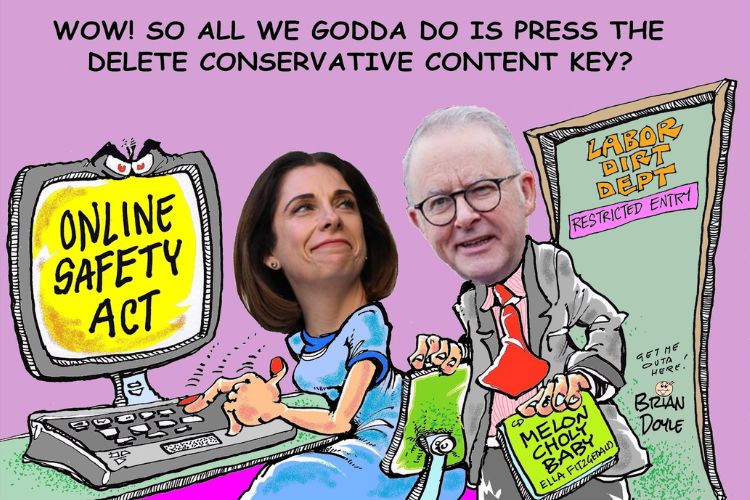
Australia’s proposed digital duty of care laws promise greater online safety and increased user control by switching off algorithms, but critics warn they could give ministers sweeping powers to restrict lawful content and threaten free speech.
16 October 2026
3.3 MINS
Jesus is calling us to love one another “just as I have loved you”. And if the Church does awaken to that agape (love), the world will see a great and powerful witness to Christ and his kingdom.

15 October 2026
4.2 MINS
Many Australian Christians don’t know a single Aboriginal person. Robyn Murray argues that reconciliation begins with honest history, prayer and a shared life in Christ.



Well said Amen
Thank you for this clear and concise explanation. We need to be informed as Christians so that we can speak to family and friends to make these planned changes widely known .